
18 Aug The Value of All Emotions
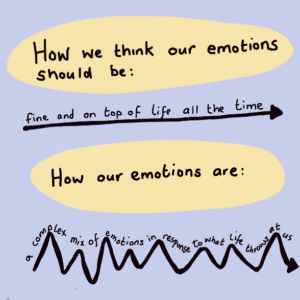
Very often I hear adults working with children describe emotions in terms of ‘good’ emotions and ‘bad’ emotions. Let’s think about this… Is it really ‘bad’ to feel sad when play time is over? Is it ‘bad’ to be angry when your favourite toy is broken?
As adults we feel sad when we lose someone close to us or angry when our bus is late. We wouldn’t say to an adult it’s ‘bad’ to feel this way, these are very normal responses. So why would we tell children that some emotions are ‘bad’ and shouldn’t be felt?
Russ Harris describes emotions as ‘the weather – they’re always present and constantly changing.’ But not only is it ever changing, we do not try to change or suppress the weather. Actively trying to change the weather is futile, we go with it and what’s important is we adapt our behaviours. We put on a coat, grab an umbrella and continue with our day. In a similar way, we do not need to change or suppress our emotions, we need strategies to deal with them.
Similarly, when using zones of regulation, I’ve heard adults tell children they need to ‘get back to the green zone’ but hopefully we can see how this can be very damaging for a child. We cannot tell children to ‘get back to the green zone’, it is on us to let children know that all emotions are normal and to teach them skills to manage and cope with their emotions, no matter what zone they are in.
The truth is all our emotions are useful and serve a purpose. Back in the cave man times, humans acted purely on instinct, they allowed their emotions to guide them. They ran away when they felt frightened and this kept them safe from wild animals. If these people had seen fear as a ‘bad’ emotion and tried to suppress it, humans would have died out a long time ago. Often it is seen as ‘bad’ when a child is angry, but just like our other emotions anger can be extremely useful. Anger sends us a message. People become angry when there is injustice, which has led to massive changes in our world.
When we speak to children about ‘good’ and ‘bad’ emotions we are giving children the message that some emotions are okay and others are not. We are telling them some emotions are okay to feel and others should be pushed away. Fighting away or blocking out ‘bad’ emotions is not a sustainable or an effective strategy. This will in the long-term lead to more distress and possible mental health difficulties. The ‘bad’ emotions help us survive, grow and develop as people. Before we can develop strategies to manage our emotions, first we need children to be able to describe what they are feeling. Modelling is one of the most powerful ways help children do this. Show the children around you that you feel these feelings too. For example ‘I feel really angry because I lost my purse. My heart is racing and I feel hot. I think taking some deep breaths will help me manage this angry feeling.’ Commenting out loud on the facial expressions and emotions you come across while reading stories or even watching movies can also be a great way to support children’s emotional literacy.
After a child has been shown the language to describe how they are feeling, we hope that they will start to use these sentences themselves. This in itself can be seen as a strategy to manage strong emotions. There is power in naming emotions, as a great educational psychologist I work with says, it is that idea of ‘name it to tame it’. Often just naming what we feel can make strong emotions less scary.
When children begin to understand their emotions, acceptance and validation of these emotions is key to helping children see that all emotions are okay. Feeling varied and strong emotions should be normalised to combat any feelings of shame a child may have about feeling a ‘bad’ emotion. It is really important that we actively listen to children and tune into how they are feeling. Validating emotions involves the adult listening, restating what the child has said, acknowledging the child’s feelings, linking the emotion to the trigger and normalising the feeling. For example ‘I can see you are annoyed that your toy has broken. I’m guessing that you feel cross and sad. It makes sense to me that you feel sad and angry because it is your favourite toy. It’s okay and very understandable to feel upset.’ I’m aware to some people, this may feel like a lot. Please don’t worry, this type of dialogue may be new to you and of course will take practice. Nobody is an expert but the more you try it out the more comfortable you will feel!
On a final note, often emotions are confused with the behaviours we see when children are feeling a certain way. The child who’s toy has broken may in the moment turn and roughly snatch a toy from another child. In this case, we need to disconnect the feeling from the behaviour. Being angry is okay. Snatching things is not. Of course, children will not pick this up themselves so as the adults around the child we again need to model this distinction for them. For example ‘I can see you are angry that your toy is broken. I know you are angry because you really liked that toy. It’s okay to be angry but it is not okay to snatch toys. What can we do to help you manage these angry feelings? Let’s roar like a lion, then we will see if we can find more toys to play with’
Developing emotional literacy with children takes time, but if the adults around the child continue to model this language from as early as possible children will become well equipped to name their emotions and describe how they feel. With time, it is the hope that children would learn that emotions are useful and all emotions are okay!
Aisling Hannon
Assistant Educational Psychologist