
20 Jul ECASS Top Tips: Helping your child to participate and be more independent

From birth, children are on a quest for independence. We see this as babies try to spoon-feed themselves or as they get older they may insist on putting on their shoes themselves. Opportunities to develop independence are important for so many reasons;
- It promotes confidence and self-esteem, providing them with the belief that they are competent and capable.
- It fosters self-reliance, allowing your child to feel they have control over aspects of their life
- It gives your child a sense of belonging which is important for building social relationships and contributing to society
- It develops frustration tolerance and perseverance
- It improves quality of life
We know that children develop at their own pace and total independence may not be possible for all children and young people. Participation and involvement in every-day activities are vital for human beings. Through participation we acquire skills, connect with others and find purpose and meaning. It’s true, it is the….’taking part which counts’.
There are several developmental factors that can impact on our children learning these skills. Children with speech, language and communication needs (SLCN) often find remembering instructions and keeping on task challenging. Even if you try repeating the information, this will likely still involve words and possibly expressed in slightly different ways too. They may also have additional difficulties learning motor skills.
But in addition to this the social environment is also key…us! and how we provide support. As I have experienced first-hand as a parent, when our lives are busy it can be quicker in the moment for you to put your child’s shoes on before you leave for school, to wipe them clean after using the toilet, to brush their teeth before bed when they are tired etc! Helping our children in this way can be linked with our emotions of providing care…especially difficult as they are growing up and we are coming to terms with our change in role.
Continual help can become a cycle of preventing your child from learning new skills. If your child struggles with the task and the adult always steps in to help or do the task, they lose the opportunity to practice and learn the skill!
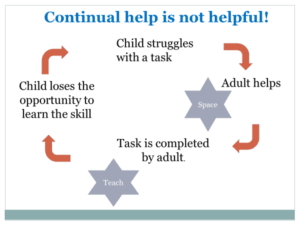
So what can we be doing at home to encourage our children to participate and develop their independence?
10 top tips:
- Wait, wait and wait some more!If your child has a level of skill at a task: just give them time and space to do that task themselves. Don’t provide help until it’s needed.
- Communication:Children with SLCN can find spoken language difficult to understand. Use clear, simple language when talking through a task or giving prompts.
Making verbal instructions visual so your child can see them and refer back to what they have to do will support them in understanding the task and doing it more independently. Visuals can be pictures or photographs broken down into the different steps.
Children with SLCN can find the concept of time difficult and so we need to make time as visual as possible. Some children have a feel for time but lack the language to understand or discuss it. Visual supports can be used to support understanding and give structure to the day, reducing anxiety about what will happen. It can also be used to teach vocabulary and concepts associated with time.
Visual timetables use symbols to represent the tasks, activities or lessons that will happen in the child/young person’s day. Having time represented visually also allows you to teach vocabulary and concepts associated with time.
- Leave extra time for the task: New skills take time to learn and by giving your child longer to complete the activity they have opportunity to practice without rushing, and without the need for you to step in.
- Routines: Practice activities within the context of the child’s routine. This makes the task practice meaningful and saves time! Routine can be especially helpful for some children who struggle with change as they know what to expect and what will happen next. Establish routines early on that you want in the long term.
- The just-right challenge:We want to encourage children to extend themselves to learn new skills (maybe outside of their comfort zones) but not feel overwhelmed with the demands of the task. This encourages skill development and improves the chance of success. We can do this by adjusting our prompts, changing the amount of assistance we provide, making the activity easier or harder, changing the activity or the tools/equipment we use or changing the environment where the task takes place.
- Breaking down the task: Break down the task into very small steps. Practise on yourself if not sure. Teach one small step at a time until you build up to the whole task.

Backwards chaining involves guiding the child through the task and they are left to complete the last part independently. Gradually you do less yourself and your child is able to do more themselves.
Forward chaining involves the child completing the first step themselves and then you guide/support them through the rest of the task.
- The art of Support: What is the least amount of support I can give my child to be successful?
You can grade the amount of support you are giving your child with each step of the task.
Physical- This can be graded from hand over hand prompting to light touches. Give opportunities for your child to be in control where they can practise.
Verbal- This can be graded from telling the child what to do, to asking questions or even holding back and not saying anything at all.
Visual- This includes modelling (showing) to using pictures. Ultimately a visual schedule can lead to a child not requiring adult support with a task.
- The Environment: Consider the best location to do the activity. Are there distractions that we could minimise or remove? Consider the social environment…Us! Do we help or hinder? Do we facilitate independence? Do we ask questions or direct? Does the whole family have the same approach?
- There are several ways to do one activity: Try different ways; sitting or standing, different techniques for shoelaces etc.
- Keep going, be consistent, it will take time!