

16 May How and why we need to be creative to ‘get our children into reading’
Dr Seuss tells us that ‘reading can take you places you have never been before’. The impact for our children of reading is clear and well documented: aside from the cultural capital, improved imagination and creativity referenced by Dr Seuss, reading supports language skills; cognitive development; concentration and much more.
The Department for Education commissioned a report by the Education Standards Research Team in 2012 which found that ‘reading enjoyment has been reported as more important for children’s educational success than their family’s socio-economic status’. Research and statistics aside, I am convinced from personal experience of the benefits of reading for both mental health and academic success. The sticking point comes for me in how we ensure that reading IS a pleasurable experience for our children: many parents recognise its importance but find that in reality, creating young bookworms and readers is easier said than done.
For those of us who teach or parent neurodiverse children, there may be a shared understanding of the difficulties involved in encouraging them to read independently or to ‘get into’ reading. For neurodiverse and children with SEN, there can be many more barriers to accessing reading than for those children who are neurotypical. If we consider levels of attention, poor concentration can be a side effects of Autism; ADHD (attention deficit hyperactivity disorder); DCD (Developmental Coordination Disorder) and Dyslexia. With this in mind, it is understandable that for many children ‘settling down with a good book’ may be quite difficult.
Likewise children with SLCN will be far more likely to struggle with accessing vocabulary in many texts. It is a widely held notion that to comprehend a text, we need to be able to read and understand 95% of the words in it and so for many children, the books they might want to read are inaccessible. As a teacher, I spent numerous parents’ evenings advocating that parents should encourage their children to read. Reflectively, I provided little guidance about how to achieve this target in practical terms.
These days, as a parent of a child with autism and SLCN, I have three top tips that I have found bridged the gap to ensure that reading is more achievable and pleasurable:
- Read to your child regardless of age
Reading to our children is especially important when they are younger. Their own reading books from school in KS1 will typically contain primarily Tier 1 (Core) words and might not stimulate their imagination and interest in the same way that books they could access through an auditory route at this stage might do.
Don’t stop there though – there are so many benefits to reading to our older children as well. Through adults reading to them (both at home and in school), we can support them to recognise and pronounce words and to develop their vocabulary. Being read to is integral in supporting comprehension: it allows the opportunity to discuss the story and for the child to develop other skills, providing them the room to imagine and to empathise. It has enabled me to discuss topics with my daughter that could otherwise be hard to bring up. We recently read ‘There’s a Boy in the Girl’s Bathroom’ by Louie Sachar and spent time talking about self-image and the impact of feeling negative about ourselves during a period in which she was experiencing some anxiety.
- Borrow or invest in audiotapes!
Audiotapes have proved quite a revelation in our household. ‘Audible’ is expensive, but it is possible to borrow audiobooks for free from ‘Borrow Box’ if you have a library card. My daughter finds it so hard concentration-wise to read pages and pages of text… audiobooks have solved this problem. She spends hours listening to stories and podcasts and creates a clear ‘safe space’ via this mentally which also appears to support her emotional regulation. Speech and Language assessments have typically found a real strength in her vocabulary and understanding of words despite difficulties elsewhere: I do think much of this is thanks to ‘Audible’ and ‘Borrow Box’.
Another plus point for audiobooks is that they bridge the gap a little for parents who are EAL or who struggle with reading themselves, providing another layer of accessibility to reading in this way.
- Don’t dismiss the graphic novel
Considering potential difficulties involving concentration and attention span, I am keen to fly the flag for graphic novels. I had previously held some snobbery about ‘comics’ – I love reading and have no lived experience of barriers in accessing longer texts. It was my husband’s idea to encourage my daughter’s reading by introducing her to some books by Raina Telegemeier and from this point, she never looked back.
Graphic novels provide visual support and stimulation that our neurodiverse and SEN readers may need: the graphics help them to decode situations and to guess or infer meaning when vocabulary is unfamiliar to them. As specialist SEN teachers we advocate frequently for ‘chunking’ text: that is the practice of dividing smaller bits of information which combine into a more meaningful whole. The way that graphic novels are segmented works perfectly for this purpose and supports any limitations in terms of short-term memory.
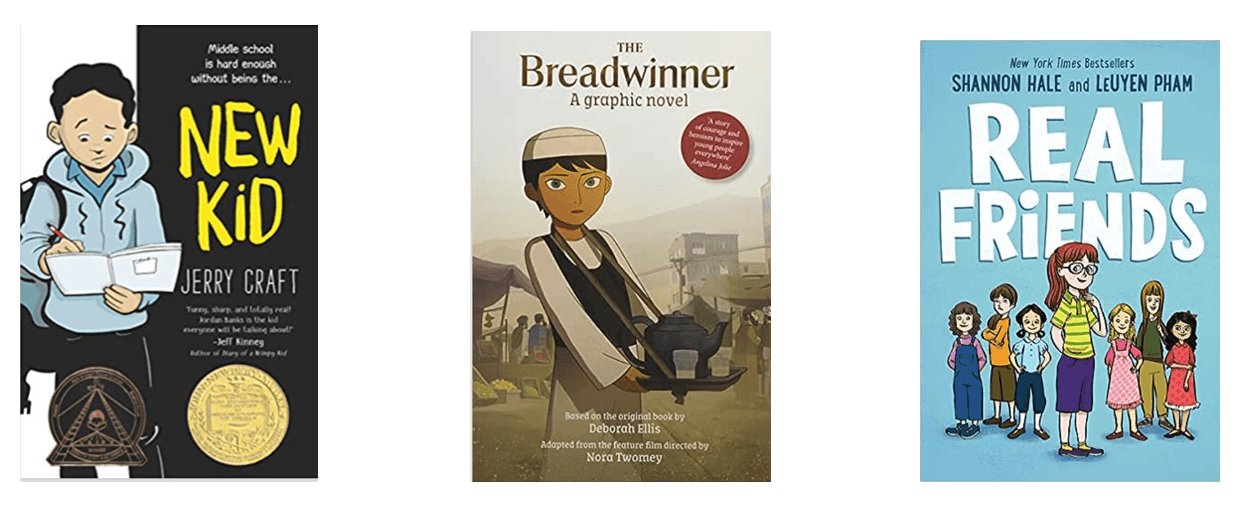
Another important element that elevates this kind of book in my mind is the topics that recent authors have chosen to deal with. My daughter and I have had great conversations off the back of her exposure to many graphic novels. In ‘New Kid’ by Jerry Craft race and privilege are a theme; she learned about the war in Iraq in ‘The Bread Winner’ by Deborah Ellis; anxiety and OCD in ‘Real Friends’ by Shannon Hale and developing social skills in the ‘Positively Izzy’ series by Terri Libenson.
The benefits of reading for all children are broad and, I believe, irrefutable but for some young readers, we may need to be more creative in our approach to encouraging reading. The key is that the book or text needs to be accessible to them: accessibility includes their ability to concentrate on the text, their understanding of the vocabulary in it and crucially, their enjoyment of it! Once they find the ‘right’ book or even audiotape initially, reading should become a pleasurable experience and something that they want to do independently.
BorrowBox – Your library in one app
30 Best Graphic Novels for Kids Aged 6 to 12 Year Olds (childhood101.com)
Graphic novels for KS2 children aged 7-11 | School Reading List